
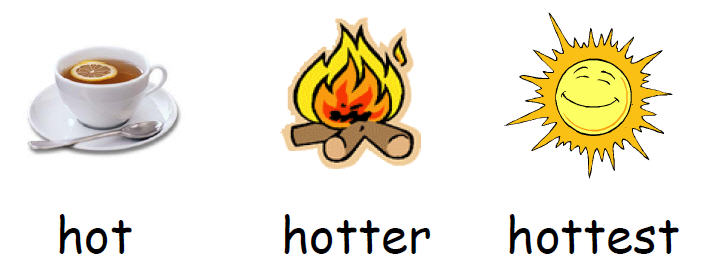
Comparatives (more, +er) and Superlatives (most, +est)

One-syllable adjectives.

Form the comparative and superlative forms of a one-syllable adjective by adding –er for the comparative form and –est for the superlative.

One-Syllable AdjectiveComparative FormSuperlative Form
talltallertallest
oldolderoldest
longlongerlongest
  • Mary is taller than Max.
  • Mary is the tallest of all the students.
  • Max is older than John.
  • Of the three students, Max is the oldest.
  • My hair is longer than your hair.
  • Max’s story is the longest story I’ve ever heard.

Two-syllable adjectives.

With most two-syllable adjectives, you form the comparative with more and the superlative with most.

Two-Syllable AdjectiveComparative FormSuperlative Form
peacefulmore peacefulmost peaceful
pleasantmore pleasantmost pleasant
carefulmore carefulmost careful
thoughtfulmore thoughtfulmost thoughtful
  • This morning is more peaceful than yesterday morning.
  • Max’s house in the mountains is the most peaceful in the world.
  • Max is more careful than Mike.
  • Of all the taxi drivers, Jack is the most careful.
  • Jill is more thoughtful than your sister.
  • Mary is the most thoughtful person I’ve ever met.

If the two-syllable adjectives ends with –y, change the y to and add –er for the comparative form. For the superlative form change the y to i and add –est.

Two-Syllable Adjective Ending
with -y
Comparative
Form
Superlative
Form
happyhappierhappiest
angryangrierangriest
busybusierbusiest
  • John is happier today than he was yesterday.
  • John is the happiest boy in the world.
  • Max is angrier than Mary.
  • Of all of John’s victims, Max is the angriest.
  • Mary is busier than Max.
  • Mary is the busiest person I’ve ever met.

Exceptions.

Irregular adjectives.

Irregular AdjectiveComparative FormSuperlative Form
goodbetterbest
badworseworst
farfartherfarthest
littlelessleast
manymoremost
  • Italian food is better than American food.
  • My dog is the best dog in the world.
  • My mother’s cooking is worse than your mother’s cooking.
  • Of all the students in the class, Max is the worst.

(For Written English Only)


The following only matter in writing and you need not concern yourselves with them for speaking.

If the one-syllable adjective ends with an e, just add –r for the comparative form and –st for the superlative form.

One-Syllable Adjective
with Final -e
Comparative FormSuperlative Form
largelargerlargest
wisewiserwisest
  • Mary’s car is larger than Max’s car.
  • Mary’s house is the largest of all the houses on the block.
  • Max is wiser than his brother.
  • Max is the wisest person I know.

If the one-syllable adjective ends with a single consonant with a vowel before it, double the consonant and add –er for the comparative form; and double the consonant and add –est for the superlative form.

One-Syllable Adjective Ending with a Single Consonant with a Single Vowel before ItComparative FormSuperlative Form
bigbiggerbiggest
thinthinnerthinnest
fatfatterfattest
  • My dog is bigger than your dog.
  • My dog is the biggest of all the dogs in the neighborhood.
  • Max is thinner than John.
  • Of all the students in the class, Max is the thinnest.
  • My mother is fatter than your mother.
  • Mary is the fattest person I’ve ever seen.

Two-syllable adjectives that follow two rules. These adjectives can be used with -er and -est and with more and most.

Two-Syllable AdjectiveComparative FormSuperlative Form
clevercleverercleverest
clevermore clevermost clever
gentlegentlergentlest
gentlemore gentlemost gentle
friendlyfriendlierfriendliest
friendlymore friendlymost friendly
quietquieterquietest
quietmore quietmost quiet
simplesimplersimplest
simplemore simplemost simple
  • Big dogs are gentler than small dogs.
  • Of all the dogs in the world, English Mastiffs are the gentlest.
  • Big dogs are more gentle than small dogs.
  • Of all the dogs in the world, English Mastiffs are the most gentle.

Two-syllable adjectives ending in –er, -le, or –ow take –er and –est to form the comparative and superlative forms.  (Technically, this is true as a rule, but using the ‘more’ and ‘most’ forms do not hurt my ears; therefore and especially for speaking, the general rule is ok.)

Two-Syllable Adjective Ending
with -er, -le, or -ow
Comparative FormSuperlative Form
narrownarrowernarrowest
gentlegentlergentlest
  • The roads in this town are narrower than the roads in the city.
  • This road is the narrowest of all the roads in California.
  • Big dogs are gentler than small dogs.
  • Of all the dogs in the world, English Mastiffs are the gentlest.

Adjectives with three or more syllables.

For adjectives with three syllables or more, you form the comparative with more and the superlative with most.

Adjective with Three or More SyllablesComparative FormSuperlative Form
generousmore generousmost generous
importantmore importantmost important
intelligentmore intelligentmost intelligent
  • John is more generous than Jack.
  • John is the most generous of all the people I know.
  • Health is more important than money.
  • Of all the people I know, Max is the most important.
  • Women are more intelligent than men.
  • Mary is the most intelligent person I’ve ever met.
Journal Writing – Rules & Guidelines

Rules

Rules must be followed. Rules are like laws.

  • When you write your journals, you must do the following:
    1. Write an outline
      • When you write a P.R.E.P. answer, I want to see an outline (in bullet point form) for your ‘R’ (reason) and ‘E’ (examples)
      • When you write a P.R.E.O.P. answer, I want to see an outline (in bullet point form) for your ‘R’ (reason), ‘E’ (examples), and ‘O’ (“on the other hand”, counter-examples)
    2. Write a first draft
    3. Proofread, edit, and rewrite
      • Remember: the single best piece of writing advice to improve writing that you, everyone, can do to improve your writing is to rewrite. Remember, genius rewrites, and you should too.
    4. Write your second (or final) draft

Rules

  • All pronouns must logically point to a noun

Points on style – “style points”

  • Write with verbs
    • English is a verb centered language.   Verbs have energy
  • Do not shift person.
    • Write in the first person for personal, subjective, accounts
    • Write in the third person for academic, objective, writing
    • Write in the second person, often using the imperative mood, for giving instructions or directions
      • Question: Do you think that morality should be taught as a subject at schools?

        “I don’t think I need to learn morality at school because people have morals unless they are psychopaths. And even if you learn morality at school, people don’t become moral. Even if you learn morality, students will be tired of moral classes. So I don’t think I need to learn morality at school.”
  • Do not shift verb tense; stay in the same verb time

    What is “verb tense”? Remember that verbs have two main parts: action and time.
    • When writing in the past, stay in the past

Guidelines

Guidelines are weaker, less strict, than rules, which must be followed. Another idiom for “guideline” is “rule of thumb”. Guidelines and rules of thumb are suggestions for best practices.

“Guideline” comes from woodworking, carpentry. A guideline gives carpenters a path to follow while sawing wood.

  • When sentencing, punishing, criminals, judges almost always follow sentencing guidelines for punishments to fit criminals’ crimes.

“Rule of thumb” comes from a general, not perfect, measurement for an inch, which is roughly the length from the first joint to the tip of a person’s thumb. The term rule of thumb refers to a general way of doing something that, though not always perfect, provides a handy way to complete the task at hand.

  • If you are having computer problems, a good rule of thumb is to restart the computer.

Rules for Using Commas

Comma Use

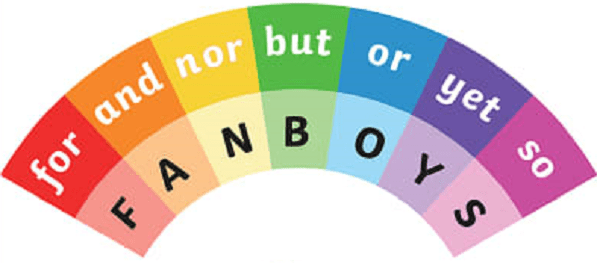
1. Use commas to separate two independent clauses when they are joined by any of these seven coordinating conjunctions: and, but, or, for, nor, so, yet.

  • What is an independent clause?
    • An independent clause can stand on its own as a complete sentence.
  • Do you remember the rules for an independent clause, also known as a complete sentence?
    • An independent clause or complete sentence must have the following:
      1. Verb
      2. Subject
      3. Complete idea

Examples:

  • The game was over, and we went home.
  • The game was over, but the crowd refused to leave.
  • The student explained her question, yet the instructor still didn’t seem to understand.
  • Yesterday was her brother’s birthday, so we had a surprise birthday party for him.

Notice the following:

  • My grandfather is old and wise.
  • My grandfather is old and has wisdom.
  • My grandfather is old, and he is wise.

2. Use commas after introductory a) clauses, b) phrases, or c) words that come before the main clause.

a. Common starter words for introductory clauses that should be followed by a comma include after, although, as, because, if, since, when, while.

While I was eating, the cat scratched at the door.

Because her alarm clock was broken, she was late for class.

If you are ill, you ought to see a doctor.

When the snow stops falling, we’ll shovel the driveway.

However, don’t put a comma after the main clause when a dependent (subordinate) clause follows it (except for cases of extreme contrast).

INCORRECT: The cat scratched at the door, while I was eating.CORRECT: She was still quite upset, although she had won the Oscar. (This comma use is correct, because it is an example of extreme contrast.)

b. Common introductory phrases that should be followed by a comma include participial and infinitive phrases, absolute phrases, nonessential appositive phrases, and long prepositional phrases (over four words).

Having finished the test, he left the room.

To get a seat, you’d better come early.

After the test but before lunch, I went jogging.

The sun radiating intense heat, we sought shelter in the cafe.

c. Common introductory words that should be followed by a comma include yes, however, well.

Well, perhaps he meant no harm.

Yes, the package should arrive tomorrow morning.

However, you may not be satisfied with the results.

3. Use a pair of commas in the middle of a sentence to set off clauses, phrases, and words that are not essential to the meaning of the sentence. Use one comma before to indicate the beginning of the pause and one at the end to indicate the end of the pause.

Here are some clues to help you decide whether the sentence element is essential:

  • If you leave out the clause, phrase, or word, does the sentence still make sense?
  • Does the clause, phrase, or word interrupt the flow of words in the original sentence?
  • If you move the element to a different position in the sentence, does the sentence still make sense?

If you answer “yes” to one or more of these questions, then the element in question is nonessential and should be set off with commas. Here are some example sentences with nonessential elements:

Clause: That Tuesday, which happens to be my birthday, is the only day when I am available to meet.

Phrase: This restaurant has an exciting atmosphere. The food, on the other hand, is rather bland.

Word: I appreciate your hard work. In this case, however, you seem to have over-exerted yourself.

4. Do not use commas to set off essential elements of the sentence, such as clauses beginning with that (relative clauses). That clauses after nouns are always essential. That clauses following a verb expressing mental action are always essential.

  • That clauses after nouns:
    • The book that I borrowed from you is excellent.
    • The apples that fell out of the basket are bruised.
  • That clauses following a verb expressing mental action:
    • She believes that she will be able to earn an A.
    • He is dreaming that he can fly.
    • I contend that it was wrong to mislead her.
    • They wished that warm weather would finally arrive.
  • Examples of other essential elements (no commas):
    • Students who cheat only harm themselves.
    • The baby wearing a yellow jumpsuit is my niece.
    • The candidate who had the least money lost the election.
  • Examples of nonessential elements (set off by commas):
    • Fred, who often cheats, is just harming himself.
    • My niece, wearing a yellow jumpsuit, is playing in the living room.
    • The Green party candidate, who had the least money, lost the election.
    • Apples, which are my favorite fruit, are the main ingredient in this recipe.
    • Professor Benson, grinning from ear to ear, announced that the exam would be tomorrow.
    • Tom, the captain of the team, was injured in the game.
    • It is up to you, Jane, to finish.
    • She was, however, too tired to make the trip.
    • Two hundred dollars, I think, is sufficient.

5. Use commas to separate three or more words, phrases, or clauses written in a series.

  • The Constitution establishes the legislative, executive, and judicial branches of government.
  • The candidate promised to lower taxes, protect the environment, reduce crime, and end unemployment.
  • The prosecutor argued that the defendant, who was at the scene of the crime, who had a strong revenge motive, and who had access to the murder weapon, was guilty of homicide.

6. Use commas to separate two or more coordinate adjectives that describe the same noun. Be sure never to add an extra comma between the final adjective and the noun itself or to use commas with non-coordinate adjectives.

Coordinate adjectives are adjectives with equal (“co”-ordinate) status in describing the noun; neither adjective is subordinate to the other. You can decide if two adjectives in a row are coordinate by asking the following questions:

  • Does the sentence make sense if the adjectives are written in reverse order?
  • Does the sentence make sense if the adjectives are written with and between them?

If you answer yes to these questions, then the adjectives are coordinate and should be separated by a comma. Here are some examples of coordinate and non-coordinate adjectives:

He was a difficult, stubborn child. (coordinate)They lived in a white frame house. (non-coordinate)She often wore a gray wool shawl. (non-coordinate)Your cousin has an easy, happy smile. (coordinate)

The 1) relentless, 2) powerful 3) summer sun beat down on them. (1-2 are coordinate; 2-3 are non-coordinate.)

The 1) relentless, 2) powerful, 3) oppressive sun beat down on them. (Both 1-2 and 2-3 are coordinate.)

7. Use a comma near the end of a sentence to separate contrasted coordinate elements or to indicate a distinct pause or shift.

  • He was merely ignorant, not stupid.
  • The chimpanzee seemed reflective, almost human.
  • You’re one of the senator’s close friends, aren’t you?
  • The speaker seemed innocent, even gullible.

8. Use commas to set off phrases at the end of the sentence that refer to the beginning or middle of the sentence. Such phrases are free modifiers that can be placed anywhere in the sentence without causing confusion. (If the placement of the modifier causes confusion, then it is not “free” and must remain “bound” to the word it modifies.)

Nancy waved enthusiastically at the docking ship, laughing joyously. (correct)

INCORRECT: Lisa waved at Nancy, laughing joyously. (Who is laughing, Lisa or Nancy?)Laughing joyously, Lisa waved at Nancy. (correct)Lisa waved at Nancy, who was laughing joyously. (correct)

9. Use commas to set off all geographical names, items in dates (except the month and day), addresses (except the street number and name), and titles in names.Birmingham, Alabama, gets its name from Birmingham, England.July 22, 1959, was a momentous day in his life. Who lives at 1600 Pennsylvania Avenue, Washington, DC?Rachel B. Lake, MD, will be the principal speaker.

(When you use just the month and the year, no comma is necessary after the month or year: “The average temperatures for July 1998 are the highest on record for that month.”)

10. Use a comma to shift between the main discourse and a quotation.

John said without emotion, “I’ll see you tomorrow.”

“I was able,” she answered, “to complete the assignment.”

In 1848, Marx wrote, “Workers of the world, unite!”

11. Use commas wherever necessary to prevent possible confusion or misreading.

To George, Harrison had been a sort of idol.

Comma abuse

Commas in the wrong places can break a sentence into illogical segments or confuse readers with unnecessary and unexpected pauses.

12. Don’t use a comma to separate the subject from the verb.

INCORRECT: An eighteen-year-old in California, is now considered an adult.

INCORRECT: The most important attribute of a ball player, is quick reflex actions.

13. Don’t put a comma between the two verbs or verb phrases in a compound predicate.

INCORRECT: We laid out our music and snacks, and began to study.

INCORRECT: I turned the corner, and ran smack into a patrol car.

14. Don’t put a comma between the two nouns, noun phrases, or noun clauses in a compound subject or compound object.

INCORRECT (compound subject): The music teacher from your high school, and the football coach from mine are married.

INCORRECT (compound object): Jeff told me that the job was still available, and that the manager wanted to interview me.

15. Don’t put a comma after the main clause when a dependent (subordinate) clause follows it (except for cases of extreme contrast).INCORRECT: The cat scratched at the door, while I was eating.CORRECT: She was still quite upset, although she had won the Oscar. (This comma use is correct, because it is an example of extreme contrast)

Comma Usage – Dependent and Independent Clauses Joined by Coordinating Conjunctions

1. Use a comma to separate two independent clauses when they are joined by any of these seven coordinating conjunctions: and, but, or, for, nor, so, yet.

2. DO NOT use a comma to separate a compound predicate (verb), a sentence with one subject and two verbs.

All of the following are correct. Can you spot and explain the differences?

  • I went home at 9 p.m. last night. I immediately fell asleep.
  • I went home at 9 p.m. last night, and I immediately fell asleep.
  • I went home at 9 p.m. last night and immediately fell asleep.

Answers:

  • I went home at 9 p.m. last night. I immediately fell asleep.
    • These are two complete sentences.
  • I went home at 9 p.m. last night, and I immediately fell asleep.
    • This is an example of two independent clauses joined by a coordinating conjunction, FANBOYS.
      • What is an independent clause?
        • An independent clause can stand on its own as a complete sentence.
        • Do you remember the rules for a complete sentence?
          • An independent clause or complete sentence must have the following:
            1. Verb
            2. Subject
            3. Complete idea
  • I went home at 9 p.m. last night and immediately fell asleep.
    • This example sentence has one subject, “I”, and two verbs, “went” and “fell asleep”:
      1. “I went home last night”
      2. “immediately fell asleep.”
    • DO NOT use a comma to separate the coordinating conjunction for sentences with a compound predicate (verb), a sentence with one subject and two verbs.
Examples:
  • The game was over, and we went home.
  • The game was over, but the crowd refused to leave.
  • The student explained her question, yet the instructor still didn’t seem to understand.
  • Yesterday was her brother’s birthday, so we had a surprise birthday party for him.
Notice the following:
  • My grandfather is old. He has the wisdom (지혜) that comes with age.
  • My grandfather is old and has the wisdom that comes with age.
  • My grandfather is old, and he has the wisdom that comes with age.

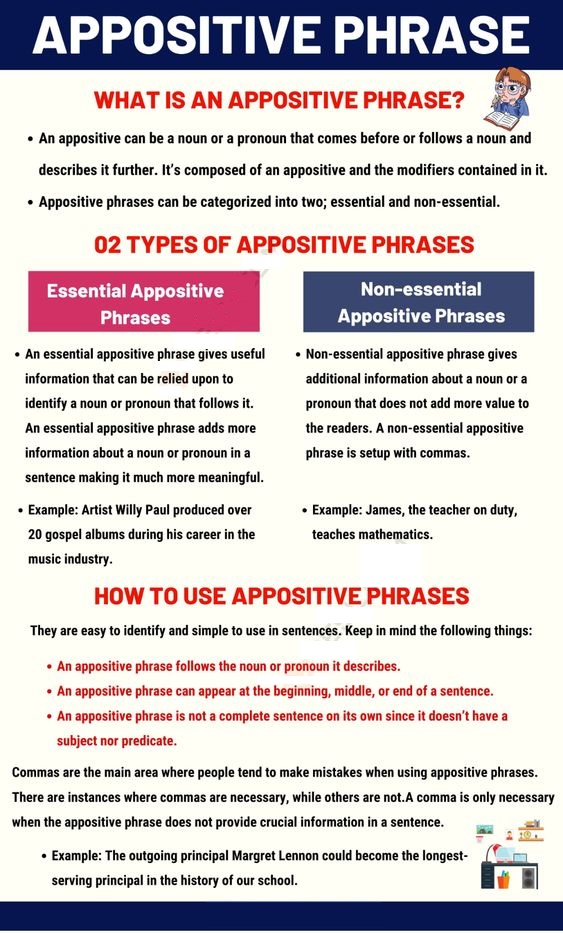
Appositive Practice

An appositive is a noun or noun phrase that renames another noun right beside it. The appositive can be a short or long combination of words.

Look at these appositive examples, all of which rename “dog”:

  1. Find the appositives
  2. What part of speech (n., v., adj., adv) are they and what part of speech are they replacing?
    • My dog, a golden retriever, is my best friend.
    • My dog, “Cinnamon”, is my best friend.
    • My dog, a golden retriever, a dog bred for working and hunting is my best friend.
    • My dog, our family pet, is truly man’s, specifically my, best friend.
    • My dog, a four-year old golden retriever, is truly man’s, specifically my, best friend.
Essential appositive phrases (defining) and non-essential appositive phrases (non-defining, extra detail)
  1. Read the following carefully. What is the difference?
  2. Now listen to me or read the sentences aloud. Can you hear the difference?
  3. What is the difference in meaning?
  • My younger brother who went to UConn, the University of Connecticut, is now a lawyer.
  • My younger brother, who went to UConn, the University of Connecticut, is a lawyer.
  • Rice is literally served at every meal, breakfast, lunch, and dinner, in Korea. The idiom, the way people ask you (for example, “what do you do?” for “what is your job?” in English) for “have you eaten today?” literally translates to “have you had rice today?” That’s how rice is so inextricably woven into the fabric of the culture, everyday life in Korea.

    They definitely know how to make rice here, in Korea, and every home, even a university student’s one room apartment, has a rice maker, a sort of pressure cooker for rice. I ate more rice in my first three months here than I had eaten in the previous 30 years, my whole life in the U.S.

    If I go too long without drinking milk, my body, even to my soul, just doesn’t feel right. My wife said that while she lived in London that she noticed the same, that her body felt strange, without eating rice.
  • My grandmother, once young with her whole life ahead of her, has had more yesterdays than she will have tomorrows.
  • My grandmother, my mother’s mother, was born in Ireland.
  • My grandmother, my father’s mother, was born in Italy.
  • My car
    • My car, a white Hyundai Avante, is reliable.
    • My car, a four-door “dad mobile”, is a good family car.
    • I’ve had my car, a 10 year-old car that I bought used, for five years.
    • My car, a plain gasoline engine sedan, runs well.
Find the appositives – “My Grandmother”

My grandmother, my mother’s mother and an Irish immigrant, had four children, Robert, Nancy, Richard, and Linda. Robert, the oldest and called “Bob”, became a priest. Nancy, my mother, had five children. Richard, the younger son, lives in Florida. Linda, the youngest, the baby of the family, is now a grandmother.

  • How many people?
    • My grandmother, my mother’s mother and an Irish immigrant, had four children.
    • My grandmother, my mother’s mother, and an Irish immigrant, had four children.
      • What’s the lesson? BE CAREFUL !
  • What’s the difference?
    • My sister who graduated from UConn, the University of Connecticut, is smart.
    • My sister, who graduated from UConn, the University of Connecticut, is smart.
      • Hint: one is “defining” and the other is “an extra detail”. How does defining vs. extra detail change the meaning, at least the feeling, of the sentence?
Appositive Writing Practice
  • January, _______, is my favorite month.
    • a fresh beginning
    • ______________
  • February, _______, is my favorite month.
    • the shortest month
    • ______________
  • March, _______, is my favorite month.
    • the start of the new school year
    • ______________
  • April, _______, is my favorite month.
    • the beginning of baseball season
    • a time when all baseball teams have hope
    • ______________
  • May, _______, is my favorite month.
    • when flowers bloom
    • ______________
  • June, _______, is my favorite month.
    • my birth month
    • ______________
  • July, _______, is my favorite month.
    • the start of beach season
    • when Korean schools start summer vacation
    • ______________
  • August, _______, is my favorite month.
    • Korea’s hottest month
    • ______________
  • September, _______, is my favorite month.
    • harvest time before Chuseok
    • ______________
  • October, _______, is my favorite month.
    • the time leaves change color
    • ______________
  • November, _______, is my favorite month.
    • the quiet time before Christmas
    • ______________
  • December, _______, is my favorite month.
    • Christmas holiday season
    • a time when Christmas music fills the air
    • ______________
  • January, _______, is my least favorite month.
  • February, _______, is my least favorite month.
  • March, _______, is my least favorite month.
  • April, _______, is my least favorite month.
  • May, _______, is my least favorite month.
  • June, _______, is my least favorite month.
  • July, _______, is my least favorite month.
  • August, _______, is my least favorite month.
  • September, _______, is my least favorite month.
  • October, _______, is my least favorite month.
  • November, _______, is my least favorite month.
  • December, _______, is my least favorite month.
  • Korea’s hottest month Korea’s coldest month
  • my birth month
  • the rainiest month peak monsoon season
  • Christmas season the start of the new year
  • four weeks of summer vacation
  • the start of baseball season
  • the time with trees at their most colorful
  • the best time to ____
    • swim ski fly kites
    • go apple picking
  • when my family
    • takes a winter vacation
    • takes a summer vacation
    • makes kimchi
    • plants rice and vegetables
    • picks rice and vegetables
Design a site like this with WordPress.com
Get started