What Korean language idiom has an interesting story behind it?
Has the meaning of the idiom changed over time?
The Lion’s Share
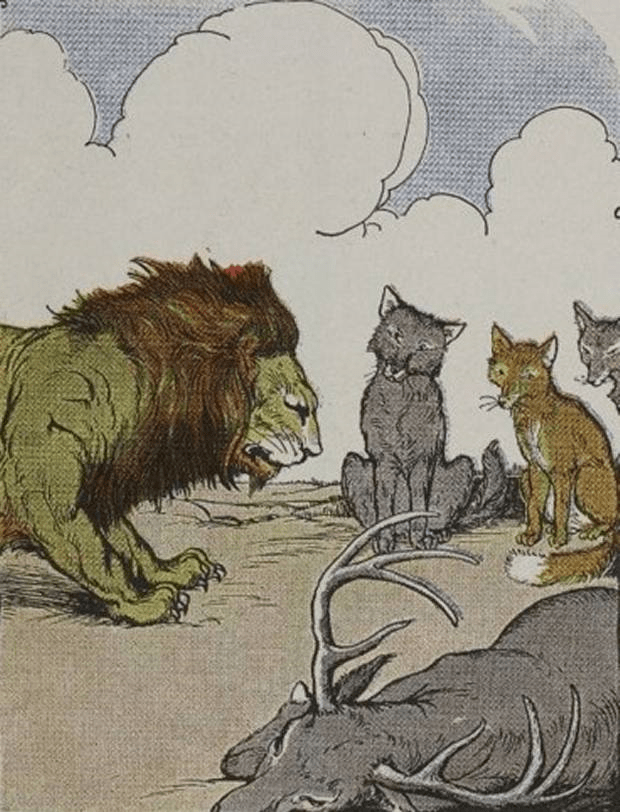
The Lion went hunting along with the Fox, the Jackal, and the Wolf. They hunted and they hunted until at last they surprised a deer and soon took its life. Then came the question how to divide the prize. “Divide for me this deer,” roared the Lion.
So the other animals skinned it and cut it into four parts. Then the Lion took his stand in front of the deer’s meat and pronounced judgment:
“The first quarter is for me in my capacity as King of Beasts; the second is mine as the one who decides; another share comes to me for my part in the chase; and as for the fourth quarter, …well, as for that, I would like to see which of you will dare to lay a paw upon it.”
“Humph,” grumbled the Fox, the Jackal, and the Wolf as they walked away with their tails between their legs, but they grumbled in a low growl.
“You may share the labors of the great, but you will not share the spoil.”
“The lion’s share” is an English language idiom that has come to mean “the biggest portion” or “the biggest share” or “the most” in the sense of when something that is limited in quantity gets divided. The original meaning has drifted over time, but the English language phrase “the lion’s share” definitely had its origin in Aeseop’s fables.
Idiom: “the lion’s share” Meaning: the biggest portion of something that is divided Usage: “The lion’s share of (discretionary) government spending goes to the military”
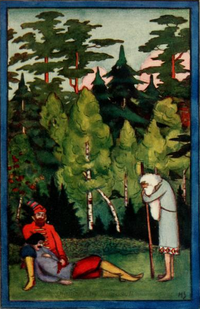
(“The Three Questions” is a short story by Russian author Leo Tolstoy first published in 1885 as part of the collection What Men Live By, and Other Tales. The story takes the form of a parable, and it concerns a king who wants to find the answers to what he considers the three most important questions in life. This post’s featured image is a 1916 cover illustration by Michael Sevier.)
The Three Questions – 1916 Cover Illustration by Michael Sevier
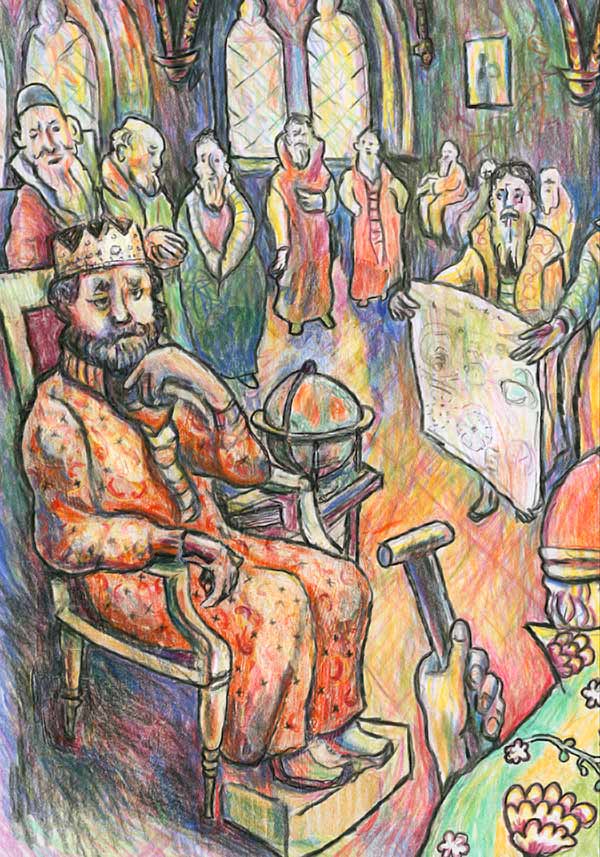
A certain king once had a revelation. If he always knew the right time to begin everything, if he knew the right people to listen to and wrong to avoid, and above all, if he always knew the most important thing to do, he would never fail in anything he might do.
He proclaimed throughout his kingdom that he would reward anyone who could teach him when was the right time for every action, who were the most necessary people, and what was the most important thing to do.
Scholars came to the King, but they all answered his questions differently.
Replying to the King’s first question, some said that to know the right time for every action, one must draw up in advance a table of days, months, and years and must live strictly by it. Only by scheduling could everything be done at its proper time. Others declared that deciding beforehand the right time for every action was impossible, but by not letting oneself be absorbed in idle pastimes, one could always attend to all of the days’ demands and then do what was needed most. Still others said that no matter how attentive the King might be to each day’s demands, deciding the right time for every action was impossible for one man. The King should have a Council of Wise Men help him set the proper time for all activities.
Then still others said some days’ demands could not wait to be laid before a council. One had to decide immediately whether to undertake them, and in order to decide, one must know beforehand what would result. Only magicians know beforehand. Therefore, one must consult magicians.
Answers to the second question were as disparate. Some said the people the King most needed were his councilors. Others said his priests. Still others said his doctors. Some said his warriors were the most necessary.
For the third question – what was the most important occupation? – some replied science. Others said skill in warfare, and others replied religious worship.
Offered differing answers, the King agreed with none and gave the reward to no one. Still wishing to find the right answers to his questions, the King decided to consult a hermit known for his wisdom.
The hermit lived in woods, which he never left, and received only common folk. Wearing simple clothes and before reaching the hermit’s hold, the King dismounted from his horse. Leaving his bodyguard behind, he went on alone.
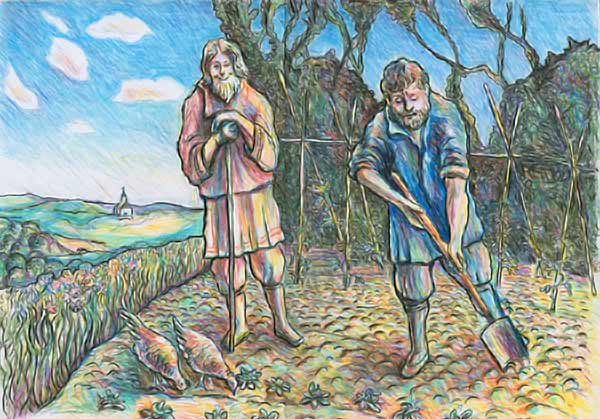
When the King approached, the hermit was tilling the ground before his hut. Not recognizing the disguised King, the hermit, frail and weak, greeted him and went on tilling. Each time the hermit stuck his spade into the ground and turned a little earth, he breathed heavily.
The King approached the hermit. “I have come to you to ask you to answer three questions, wise hermit. How can I know to do the right thing at the right time? Who are the people I need most and to whom should I, therefore, pay most attention to? What affairs are most important and need my first attention?”
The hermit listened and said nothing. He spat on his hands and continued digging.
“You are tired. Let me take the spade and work for you for awhile,” said the King.
“Thank you”, said the hermit. Having handed the spade to the King, the hermit rested on the ground.
After he had dug two beds, the King stopped and repeated his questions. The hermit listened and again gave no answer. The hermit rose and motioned for the spade. “Rest and let me work the soil for awhile.”
But the King did not give him the spade and continued tilling the soil. An hour passed, and then another. The sun sank behind the trees. The King at last struck the spade into the ground and said “I came to you, wise man, for an answer to my questions. If you can’t give me one, tell me. I will return home.”
“Here comes someone running,” the hermit said. “Let’s see who he is.”
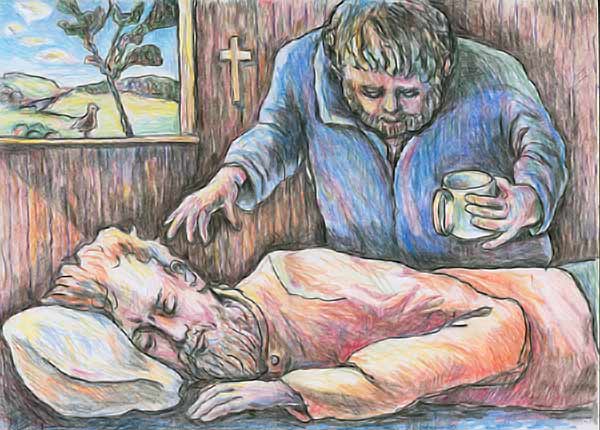
The King turned around and saw a bearded man come running out of the woods. The man held his hands, blood flowing from beneath, pressed against his stomach. Reaching the King, he feebly fell and groaned on the ground. The King and the hermit unfastened the man’s clothing. The man had a large gash in his stomach. The King washed and bandaged the wound as best he could with his handkerchief. The blood would not stop flowing. The King repeatedly removed the blood soaked bandage, washing and redressing the wound. When at last his bleeding stopped, the man revived and asked for something to drink. The King drew and gave fresh water to him.
Meanwhile the sun set, and the evening became cool. With the hermit’s help, the King carried the hurt man into the hermit’s hut and laid him on the bed. Lying on the bed, the man closed his eyes and rested. The King, tired from his walk and his long day’s work, lay down in the doorway and fell asleep so soundly that he slept through the short summer night.
Upon awaking in the morning, the King needed time before he could remember where he was and who was the strange bearded man, gazing intently at him with shining eyes, lying on the bed.
The bearded man saw that the King was awake and looking at him. “Forgive me,” he said in a weak voice.
“I do not know you and have no offense to forgive you for,” said the King.
“You do not know me, but I know you. I am the enemy who swore to revenge himself on you because you executed his brother and seized his property. I knew you had gone alone to see the hermit. I resolved to kill you on your way back. When the day passed and you had not returned, I set out from my ambush to find you. I came upon your bodyguard, and they wounded me. I escaped with my life. I would have bled to death if you had not bandaged my wound. I wished to kill you, but you saved me. Now if I live and you desire it, I will faithfully serve you and bid my sons to do the same. Forgive me.”
The King was happy to make peace with an enemy and have him as a friend. He forgave and told him that he would send his servants and physician to attend to him. The King promised to restore the beaded man’s property.
Leaving the wounded man, the King went onto the porch, looking for the hermit. The hermit, outside and on his knees, sowed seeds in the beds that they had dug the day before.
The King approached him and pleaded for answers to his questions. “For the last time, I pray you to answer my questions, wise man.”
“You have your answers,” said the hermit, sowing seeds on his aged knees and looking up at the King standing before him.
“I ‘have my answers’?” echoed the bewildered King. “What do you mean?”
“Don’t you see?” replied the hermit.
“If you had not pitied me for my weakness yesterday, had not dug those beds for me, and had gone your way, that man would have attacked you. You would have paid dearly for not having stayed with me. So the most important time was when you were tilling the soil. I was the most important man. Doing good for me was your most important business.”
“Afterwards, when that man ran to us, the most important time was when you were attending to him. If you had not bandaged his wounds, he would have died without having made peace with you. He was the most important man. The good you did for him was your most important business.”
“Remember then, there is only one time that is important – now! ‘Now’ is the most important time because ‘now’ is the only time when we have any power. The most important man is whomever you are with. No man knows whether he will ever have dealings with anyone else. The most important business is doing good for whom you are with because for that purpose alone was man sent into this life.”
Three Questions was first published in 1885 as part of Tolstoy’s collection, What Men Live By, and Other Tales.“There is only one time that is important—Now! It is the most important time because it is the only time when we have any power.”


 Joseph English for Kids